
holiday inn express
stephenville, texas
Category: Commercial Development | Hotel
Location: 3015 Northwest Loop, Stephenville, Erath County, Texas
Date: June 2024
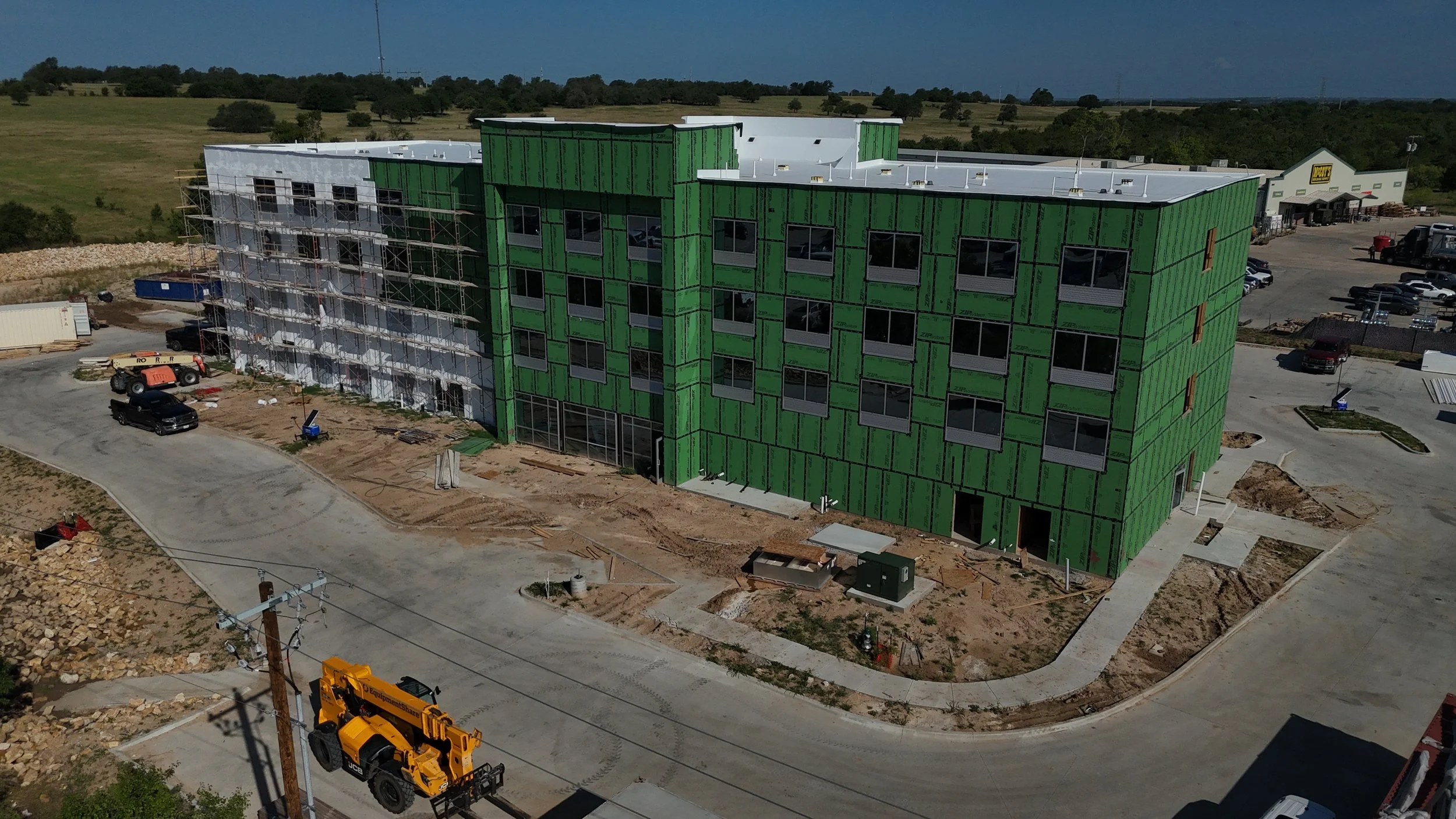
Status: Under Construction — Expected Opening December 2026
PROJECT OVERVIEW
Merritt Engineering Services provided comprehensive civil site engineering for a new four-story Holiday Inn hotel located along the Northwest Loop (Senator Robert J. Glasgow Farm to Market Road No. 988) in Stephenville, Erath County, Texas. The project represents a technically demanding hotel civil package, involving a full SCS/NRCS unit hydrograph stormwater analysis, a proposed detention pond, a designed storm channel, and a downspout collector drainage system — all in accordance with City of Stephenville and NTCOG (North Texas Council of Governments) iSWM criteria.
The project site encompasses approximately 2.72 acres, with a 12,970 SF building footprint and 4-story building height of 54'-1". The proposed hotel includes 82 parking spaces, heavy-duty concrete drive aisles, proposed xeriscaping, electric vehicle charging stations, and a proposed detention pond to attenuate increased post-development runoff prior to discharge.
Merritt Engineering produced a 35-sheet civil plan set covering all aspects of site design — from existing conditions and proposed site layout through full SCS hydrologic modeling, detention pond design, storm channel hydraulics, utility coordination, and TxDOT driveway permitting.
PROJECT SPECIFICATIONS
Project Type
Commercial Hospitality / Hotel Development
Location
3015 Northwest Loop, Stephenville, TX
Jurisdiction
City of Stephenville, Erath County, Texas
Total Lot Area
2.72 acres (118,686 SF)
Building Footprint
12,970 SF (0.30 AC)
Building Height
54'-1" (4 Stories)
Concrete Pavement
46,441 SF (1.07 AC)
Sidewalks
7,777 SF (0.18 AC)
Zoning
B-2 Retail and Commercial Business
Stormwater Method of Estimation
SCS/NRCS Unit Hydrograph (SCS Type II, 24-hr)
Surveyor
Arnold Land Surveying & Mapping
ENGINEERING SERVICES PROVIDED
Site Planning & TxDOT Coordination
The proposed site plan was developed to accommodate a four-story hotel fronting the Northwest Loop (FM 988), with access via a permitted TxDOT driveway apron from the existing roadway. The site layout includes heavy-duty concrete drive aisles, a fire lane loop around the building, proposed xeriscaping areas, EV charging stations, a dumpster pad area, and proposed rock riprap (12" D50, 18" min. thickness) at drainage outfall locations.
Design Components:
Proposed site layout with 82 parking spaces (4 ADA/TAS handicap)
TxDOT driveway apron plan per TxDOT standards (Sheet C12.01)
Existing site plan and dimension plan
Proposed xeriscaping with landscape buffer zones
Proposed electric vehicle (EV) charging station area
Proposed 6' sidewalk along Northwest Loop frontage
15'×15' sight visibility easements at driveway access
Pavement Design
Drive aisles and parking areas were designed as heavy-duty concrete pavement in accordance with City of Stephenville and geotechnical recommendations from Rone Engineering.
Pavement Sections:
Dumpster Pad: 8" 3,600 PSI Concrete w/ #4 Bars @ 12" O.C.E.W.
Firelane/Heavy Duty Drive Aisle: 7" 3,600 PSI Concrete w/ #4 Bars @ 12" O.C.E.W.; 8" Subgrade compacted to 95% Max Density
Parking Areas: 6" 3,600 PSI Concrete w/ #4 Bars @ 12" O.C.E.W.; 8" Subgrade compacted to 95% Max Density
Sidewalks: 4" 3,500 PSI Concrete w/ #3 Bars @ 18" O.C.E.W.; 6" Compacted Subgrade
Stormwater Modeling — SCS/NRCS Unit Hydrograph Method
The City of Stephenville required stormwater runoff to be modeled using the SCS/NRCS Unit Hydrograph method — a more rigorous approach than the traditional Rational Method — applied across 1-year, 5-year, 25-year, and 100-year storm events using SCS Type II 24-hour storm distributions for Erath County. The model covered six subbasins under existing conditions and six under proposed conditions, with full hydrograph routing through the detention pond and outfall structures.
Detention Pond Design — iSWM Vmax Volume Multiplier
One of the primary site challenges on this project was the iSWM Vmax volume multiplier requirement. Per the NTCOG iSWM Criteria Manual for Site Development and Construction, the Vmax multiplier is applied to the calculated required detention storage volume as a safety factor — effectively increasing the total pond volume that must be provided on-site above the base hydrologic calculation.
On a dense hotel site like this one, that requirement created a significant design challenge. With a 4-story building, full parking field, fire lane loop, drive aisles, sidewalks, and utility infrastructure all competing for space on a 2.72-acre lot, finding the room to accommodate the Vmax-inflated detention volume while still meeting all hotel site requirements required careful coordination of grading, layout, and pond geometry. The final design achieved compliance with the Vmax-adjusted volume requirement while maintaining the full site program.
Utility Site Plan
The utility site plan was developed in coordination with City of Stephenville Public Works, Oncor Electric, Atmos Energy, and Waste Connections, documenting all proposed water, sanitary sewer, electric, gas, and solid waste infrastructure serving the hotel.
A notable element of the sanitary sewer design was the connection to the existing 12" sanitary sewer main located on the far side of the Northwest Loop. Because open-cut installation within the TxDOT ROW was not permitted, the design required a directional bore crossing beneath the roadway — approximately 116 LF of 18" steel casing pipe (1/4" minimum wall thickness) encasing a 6" SDR 26 carrier pipe at 1.50% slope. The casing was designed to be fully welded and watertight to 150 PSI, with plastic or stainless-steel casing spacers and end seals at each end. A bore profile was included in the plan set documenting existing grade, proposed grade, casing extents, and the TxDOT ROW boundary for permit coordination.
Erosion Control Plan
A construction-phase erosion and sediment control plan was developed in compliance with TCEQ and TxDOT requirements, accounting for the site's frontage road exposure and proximity to IH-35 drainage infrastructure.
PROJECT BENEFITS
✓ Hospitality Investment in Stephenville:
Adds a new four-story branded hotel to Stephenville's hospitality inventory, supporting regional tourism and commerce near the Tarleton State University corridor - 1st hotel permit approved in the last ten years
✓ Rigorous SCS/NRCS Hydrologic Analysis:
Full unit hydrograph modeling across four storm events provided the City of Stephenville with a complete and defensible stormwater analysis meeting elevated review standards
✓ iSWM Vmax Compliance on a Constrained Site:
Meeting the iSWM Vmax volume multiplier requirement on a dense 2.72-acre hotel site required creative design coordination — the final layout successfully accommodates the full hotel program while satisfying the inflated detention storage requirement
✓ On-Site Detention Protects Downstream Neighbors:
Detention Pond A reduces post-development peak flows back to or below pre-development levels across all design storm events
✓ Complete 35-Sheet Civil Package:
A fully coordinated construction document set covering site layout, grading, drainage, SCS model results, detention pond, storm channel, downspout collector system, utility plan, erosion control, and construction details
✓ Multi-Agency Coordination:
Successful coordination with City of Stephenville Public Works and Development Services, TxDOT, Oncor, Atmos Energy, and Waste Connections
FREQUENTLY ASKED QUESTIONS
What civil engineering services are required for a hotel development in Stephenville, Texas?
Hotel developments in Stephenville typically require a full civil site engineering package including site grading and layout, heavy-duty pavement design, stormwater drainage analysis, detention pond design, utility coordination, erosion control plans, and TxDOT driveway permitting for any access from a state-maintained roadway. The City of Stephenville also requires stormwater modeling using the SCS/NRCS unit hydrograph method and compliance with NTCOG iSWM detention criteria, which are more demanding than the simplified Rational Method used in many other jurisdictions.
What is the iSWM Vmax requirement and why does it matter for site design?
The iSWM (Integrated Stormwater Management) Criteria Manual — published by the North Texas Council of Governments (NTCOG) — includes a Vmax multiplier that is applied to the calculated required detention storage volume. Rather than designing a pond to the bare minimum volume from hydrology alone, the Vmax factor increases the required storage as a safety margin. On a dense commercial site like a hotel — where the building footprint, parking field, fire lane, drive aisles, and utilities are all competing for the same ground — accommodating that inflated pond volume becomes a real design challenge that requires careful coordination of grading, layout, and pond geometry.
Does Stephenville require a detention pond for commercial development?
Yes, for most commercial development that significantly increases impervious cover, the City of Stephenville requires on-site stormwater detention to ensure post-development peak flows do not exceed pre-development rates. The detention pond must be sized in accordance with NTCOG iSWM criteria, including the Vmax volume multiplier, and must be designed to control runoff across multiple storm events — typically the 1-year, 5-year, 25-year, and 100-year events.
Why was a bore required for the sanitary sewer connection on this project?
The existing sanitary sewer main that the hotel needed to connect to was located on the opposite side of the Northwest Loop, a TxDOT-maintained roadway. TxDOT does not permit open-cut installation within the right-of-way, so the sewer service had to be installed via a directional bore beneath the roadway. This required designing a steel casing pipe to encase the PVC carrier pipe across the ROW, coordinating the bore profile with TxDOT permit requirements, and specifying casing materials and end seals to meet pressure and watertightness standards.
What pavement design is typically required for hotel drive aisles and fire lanes in Texas?
Hotel sites require heavy-duty pavement sections capable of handling loaded delivery trucks, fire apparatus, and high daily traffic cycles. For this project, fire lanes and primary drive aisles were designed as 7" 3,600 PSI concrete over 8" compacted subgrade, with parking areas at 6" 3,600 PSI concrete. Concrete is the preferred pavement type for commercial hotel sites in Central Texas due to the region's expansive clay soils, which can cause premature failure of flexible asphalt sections.
How long does civil permitting take for a hotel project in Stephenville?
Permitting timelines depend on the completeness of the submittal and the complexity of the project. A full hotel civil package — covering site, grading, drainage, utilities, and stormwater — typically requires multiple rounds of review with City of Stephenville Public Works and Development Services, as well as separate TxDOT coordination for any driveway or bore permit. Engaging a civil engineer early in the design process and producing a complete, code-compliant submittal is the most effective way to minimize review cycles and keep the project on schedule.
Does Merritt Engineering provide civil engineering services for hotel and hospitality projects outside of Stephenville?
Yes. Merritt Engineering Services provides civil site engineering for commercial and hospitality developments across the state of Texas. With over 17 years of experience working in municipalities from the Panhandle to the Gulf Coast, our team is equipped to navigate the varying drainage criteria, permitting requirements, and utility coordination processes of jurisdictions statewide. We have active project experience in Central Texas communities including Waco, Stephenville, Hillsboro, Corsicana, Granbury, and Cleburne, and we regularly take on projects well beyond that footprint. If your hotel or commercial development is in Texas, we can engineer it.